
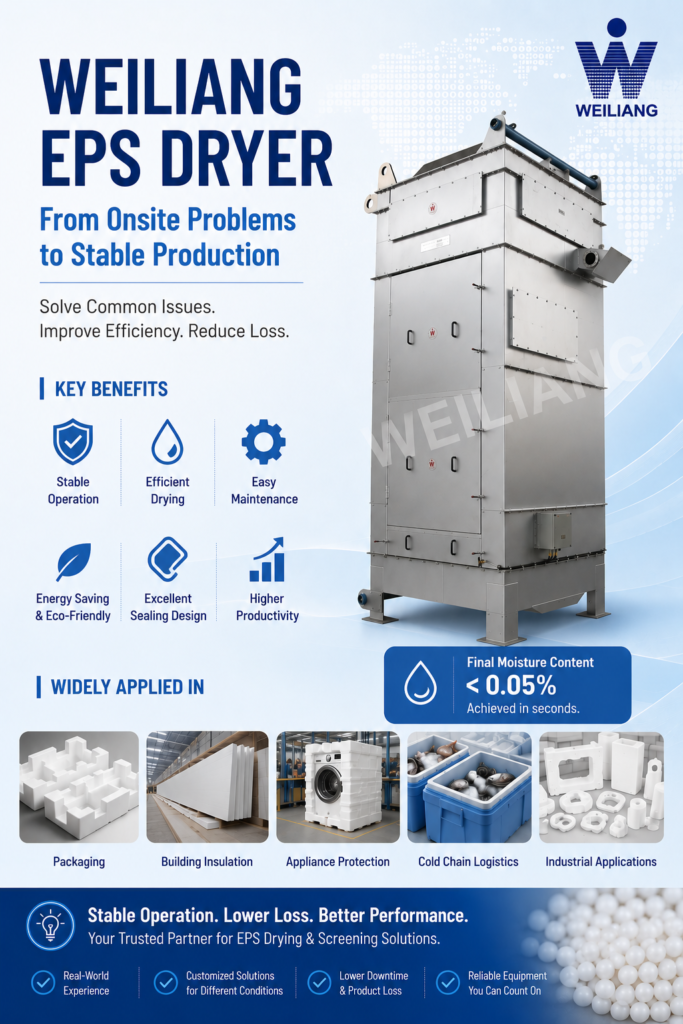
From EPS industry trends to dryer system operation challenges, this article analyzes common onsite issues such as overload shutdown, material leakage, and product loss, along with practical solutions.
1. The EPS Industry Is Facing New Changes and Challenges
In recent years, the EPS (Expanded Polystyrene) industry has continued to maintain stable demand, especially in packaging, insulation materials, appliance protective packaging, and cold-chain transportation. EPS still offers significant advantages such as lightweight structure, low cost, and excellent cushioning performance. Asia remains one of the most important global EPS production and consumption markets, with growing demand in China, India, and Southeast Asia.
At the same time, the international market environment is also having a major impact on the EPS industry.
On one hand, increasingly strict environmental policies are driving the development of sustainable packaging and recyclable materials. Regions such as the European Union are promoting plastic reduction and recycling initiatives. On the other hand, international trade tensions, tariff policies, and fluctuations in crude oil and styrene prices are directly affecting EPS raw material costs and export markets. Recently, the Asian polystyrene market has continued to face weak demand, high inventory levels, and price volatility.
Nevertheless, EPS still has irreplaceable application value. Especially in industrial packaging, cold-chain logistics, appliance protection, and building insulation, EPS remains one of the most cost-effective solutions available today.
The future direction of the industry is gradually shifting from simple “capacity competition” toward:
• More stable production processes
• Lower energy consumption
• Higher automation
• Better recycling capability
• More stable finished product quality control
Among all EPS production processes, the stability of the drying system is becoming increasingly important for overall production line efficiency.
2. Why Is the Drying Process So Important in EPS Production?
In EPS production, materials usually go through:
• Pre-expansion
• Aging
• Molding
• Drying
• Screening and conveying
During wet screening or water circulation processes, EPS particles carry a large amount of moisture into the drying system.
Because EPS particles are:
• Lightweight
• Easy to float
• Prone to static adsorption
• Easy to clog screens
The drying system must handle not only dewatering, but also:
• Drainage efficiency
• Stable material conveying
• Screen blockage
• Product loss
• Sealing performance
• Internal negative pressure control
Many customers discover during actual production that:
There is often a significant difference between theoretical design capacity and actual onsite operating capacity.
In reality, long-term operational stability depends not only on the equipment itself, but more importantly on:
• Material characteristics onsite (different formulas affect EPS particle behavior)
• Moisture ratio between particles and water
• Cleaning and maintenance frequency
• Sealing quality and product loss control
• Process matching with actual operating conditions
3. Common Onsite Problems in EPS Dryer Applications
Recently, some customers reported the following issues during operation:
• Equipment overload shutdown after increasing feeding rate, with actual throughput lower than design capacity
• Gaps between dryer screens causing finished particles to be carried away with water
• Material leakage from the top air inlet of the dryer
These issues are actually quite common in wet EPS drying applications.
3.1 Why Does Overload Occur After Increasing Feeding Rate?
Based on onsite analysis, the most common reason is:
Screen blockage
When EPS particles mixed with water enter the equipment, blockage tends to occur especially in the lower three screen layers due to particle accumulation.
Once blockage occurs:
• Internal water accumulation increases
• Drainage efficiency decreases
• Internal negative pressure rises
• Motor load increases
Eventually leading to overload shutdown.
This phenomenon has occurred in many similar applications and is not an isolated case.
Solution:
It is recommended to regularly open the inspection door and use a high-pressure water gun to clean the screen area.
Please note that fine particles tend to adhere inside the screen gaps, therefore high-pressure water cleaning is necessary instead of simple rinsing with a normal water hose.
Regular maintenance can significantly improve drainage efficiency and operational stability.
3.2 Why Does Finished Product Loss Occur?
According to onsite video analysis, the core issue is usually:
Insufficient sealing around the screen installation area.
At many sites, the sealant application process during screen installation is not properly performed, creating gaps between the screen and frame, which allows finished particles to be discharged together with water.
Especially under wet operating conditions, incomplete sealing makes it easier for fine particles to escape through these gaps.
Therefore, during screen installation, it is important to strictly follow the installation instructions, especially regarding sealant application methods and sealing uniformity.
After proper installation and sealing, material leakage and product loss can usually be significantly improved.
3.3 Why Does Material Leak from the Top Air Inlet
Based on onsite experience, the most common reason is:
The blower is not running or the airflow system has not established effective negative pressure.
Under normal conditions, the top air inlet is connected to ductwork, while the air outlet is connected to a blower. When the blower operates properly, stable negative pressure is formed inside the equipment, preventing particles from leaking from the top.
However, if:
• The blower is not running
• Airflow volume is insufficient
• Ductwork is blocked
• Airflow connections are abnormal
then proper internal air circulation cannot be established, and lightweight EPS particles may be carried out from the top air inlet.
Recommended Solution:
When proper air circulation is established throughout the system:
• Stable internal negative pressure can be maintained
• Moisture vapor can be removed more efficiently
• Surface drying performance of the particles can be improved
3.4 Minor Product Loss Is Actually Normal
Under wet screening and drying conditions, a small amount of finished particles carried away with drainage water is considered normal.
Therefore, many customers install an additional vibrating screen after the water outlet for secondary recovery in order to reduce material loss.
However, excessive product loss usually indicates:
• Sealing problems
• Screen-related issues
• Abnormal drainage systems
In such cases, further onsite analysis and optimization are required.
3.5 Stable Operation Is More Important Than Simply Increasing Capacity
For the EPS industry, future competition is no longer simply about “who has bigger equipment”.
The real challenge is:
Who can achieve more stable, continuous, and lower-maintenance production.
An excellent EPS drying system should not only provide processing capacity, but also offer:
• Long-term stable operation
• Easy maintenance
• Reliable sealing structure
• Reasonable cleaning and maintenance plans
• Better adaptation to actual operating conditions
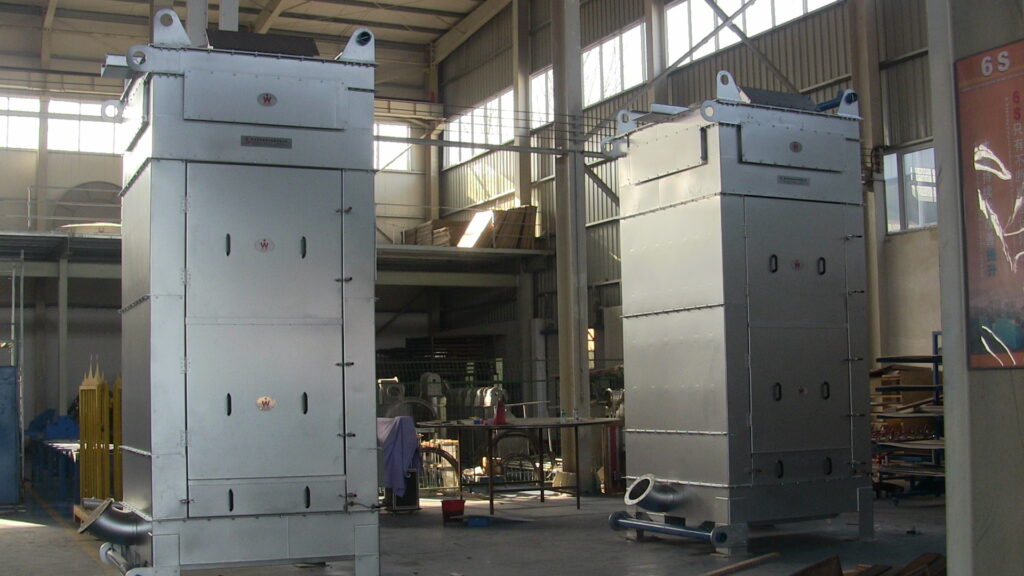
WEILIANG WLG EPS Dryer
Weiliang WLG EPS Dryer adopts centrifugal dewatering technology to achieve continuous filtration, dewatering, and rapid drying of EPS particles.
During operation, slurry enters the high-speed rotating rotor section through the inlet. Under centrifugal force, water is rapidly separated from the material and discharged through the bottom drainage outlet, while solid particles are continuously conveyed toward the discharge outlet by specially designed spiral blades inside the rotor.
At the same time, auxiliary hot air enters from the upper air inlet and flows counter-currently against the material stream. The high-pressure airflow quickly removes moisture vapor and further reduces the surface moisture content of the particles.
Because the material rotates at high centrifugal speed inside the machine, moisture on the particle surface is continuously separated away. As a result, the entire drying process can be completed within only a few seconds, with final moisture content reduced to below 0.05%.
Compared with conventional dewatering systems, the integrated filtration and drying design helps simplify the production process and improve overall production efficiency.

WEILIANG always focuses on real operating conditions, working closely with customers to analyze problems, optimize processes, improve equipment stability, reduce downtime, and minimize finished product loss.
Because for any production line:
Stable operation is always more important than short-term high output.